
Blog
/
third-party-logistics-services-future
The Future of Efficient Shipping
Jesse Stock
on
The Future of Efficient Shipping
Estimated Reading Time: 9 minutes · Published by: Shipping Bros 3PL, Springdale, AR · Last Updated: March 2026
What to Expect
This post is for brands and operators actively looking to reduce shipping costs, improve delivery speed, and build a fulfillment operation that holds up under growth. It covers where efficient shipping is heading, the tools and strategies that are separating high-performing logistics operations from slow ones right now, and what it takes to position your business to compete on delivery. If you are evaluating fulfillment partners, rethinking your carrier strategy, or trying to understand what modern 3PL services actually look like in practice, this is the right read.
Table of Contents
Why Shipping Efficiency Is Now a Buying Decision
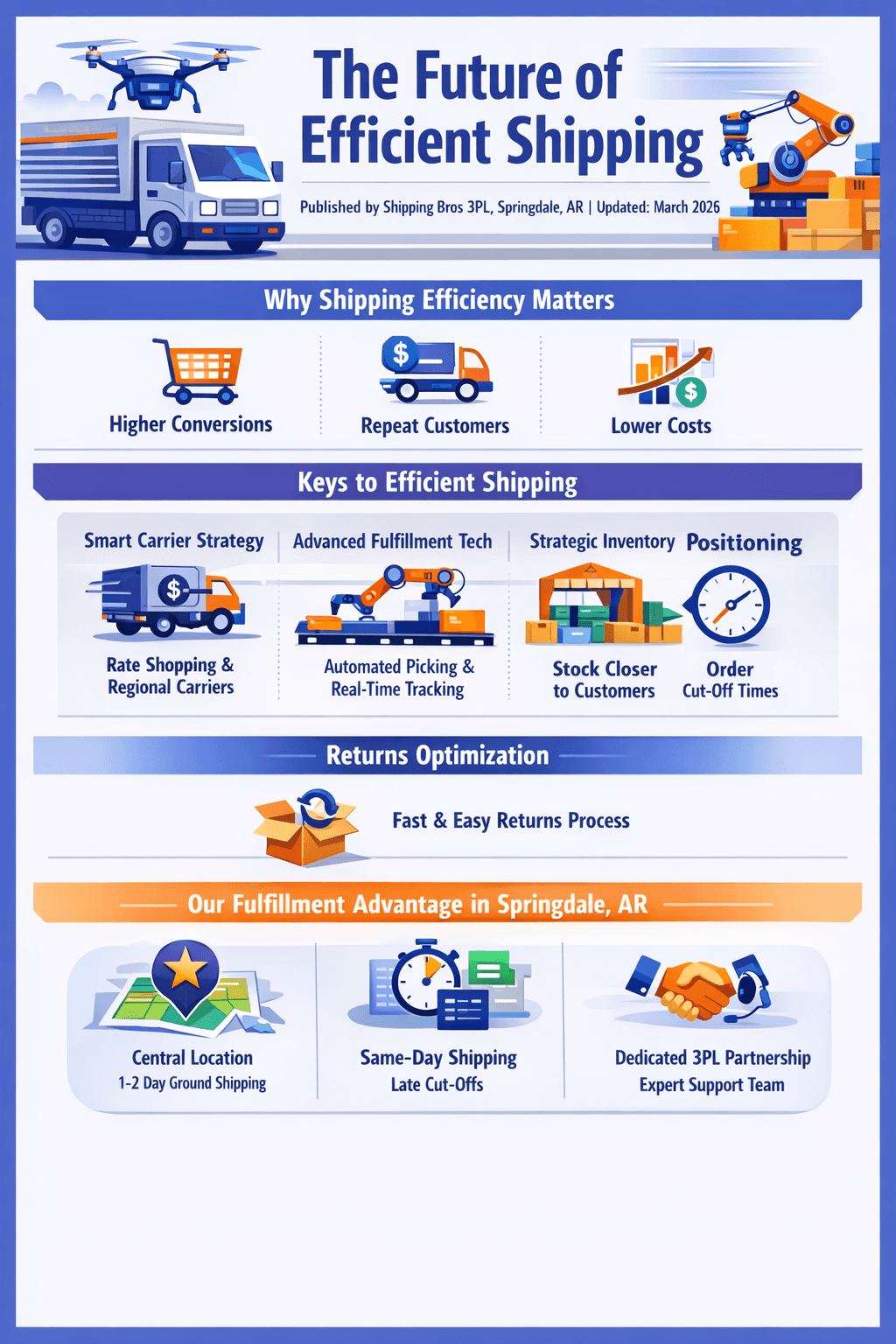
What Efficient Shipping Actually Requires
How Carrier Strategy Drives Down Cost Per Shipment
Fulfillment Technology That Closes the Gap on Amazon-Speed Delivery
Inventory Positioning as a Shipping Cost Strategy
Same Day Fulfillment and Why Cut-Off Times Matter
Returns Efficiency as a Competitive Shipping Advantage
What to Look for in a Fulfillment Partner Built for Efficient Shipping
How Shipping Bros 3PL Delivers Fast and Lean From Springdale, AR
Customers have stopped treating fast, accurate delivery as a premium feature. They treat it as the floor. A two-day delivery window is a baseline expectation in most product categories. A delayed shipment, a wrong item, or a tracking number that goes dark for three days is no longer a minor inconvenience. It is the event that pushes a customer to a competitor for the next purchase. The brands building durable customer relationships right now are the ones that have made efficient shipping a core operational priority, not an afterthought that gets attention after a product launch.
The future of efficient shipping is already taking shape inside high-performing fulfillment operations. The strategies, tools, and partnerships that define it are accessible to brands of nearly any scale. The question is whether a brand is positioned to use them.
Why Shipping Efficiency Is Now a Buying Decision
The connection between shipping performance and purchase behavior has become direct and well-documented. Customers check delivery estimates before they add to cart. They read reviews that mention shipping speed and packaging quality. They abandon checkout when delivery options do not meet their expectations, and they do not always come back.
For brands selling in competitive product categories, shipping efficiency is a buying decision driver in the same category as price and product quality. A brand that can promise and deliver two-day shipping at standard ground rates is offering something meaningful compared to a competitor that ships in three to five days at the same price point. The product does not have to change. The margin does not have to compress. The advantage comes entirely from the logistics operation behind the order.
This is why investing in efficient shipping infrastructure, whether through a 3PL fulfillment partner, a better carrier strategy, or smarter inventory positioning, generates returns that show up in conversion rate, repeat purchase rate, and customer lifetime value, not just in the shipping cost line on a P&L.
What Efficient Shipping Actually Requires
Efficient shipping is not a single decision. It is a system where several components have to function well simultaneously. When any one component underperforms, the others cannot fully compensate.
Accurate, fast order fulfillment is the starting point. An order that sits in a pick queue for 18 hours has already failed the customer before a carrier touches it. Fulfillment speed depends on warehouse management system configuration, pick path optimization, staffing, and daily cut-off time discipline. Brands evaluating 3PL services should ask how quickly orders placed in the afternoon actually ship, because that question reveals more about operational discipline than almost any other metric.
Carrier access and rate structure determine what it costs to deliver the fulfillment speed a brand is promising. Without negotiated carrier rates, shipping at competitive speeds costs more than it should, and that cost either compresses margin or gets passed to the customer in a way that hurts conversion. Third party logistics providers that ship high aggregate volume carry rate leverage that individual brands rarely achieve independently.
Inventory positioning determines the geographic distance between a product and the customer who ordered it. No amount of carrier optimization fully offsets the cost of shipping a package across the country when a nearby fulfillment center could have delivered it in two days at ground rates. Positioning inventory strategically based on customer geography is one of the highest-leverage moves in an efficient shipping strategy.
How Carrier Strategy Drives Down Cost Per Shipment
Most growing brands underinvest in carrier strategy. They set up an account with one or two carriers, accept the published rate structure, and treat shipping cost as a fixed variable. The brands that compete on efficient shipping treat carrier selection as an active optimization process.
Rate shopping at the point of label generation is the baseline. Every outbound shipment should be evaluated across carriers and service levels in real time so the least expensive option that still meets the delivery promise is always selected. A fulfillment operation that defaults to a single carrier regardless of destination and package weight is consistently overpaying on a meaningful percentage of shipments.
Regional carriers are underused by most brands. In dense shipping corridors, regional carriers often deliver faster and cheaper than national options because their networks are optimized for specific geographic areas rather than national scale. Adding regional carrier relationships to the carrier mix gives a fulfillment operation more options on price and speed in the markets where regional carriers have a structural advantage.
Dimensional weight pricing is another area where attention to packaging pays measurable dividends. Carriers charge based on whichever is greater, actual weight or dimensional weight, which is calculated from package volume. Selecting the smallest carton that safely contains the order reduces billable weight, and that reduction compounds across thousands of shipments per month. A fulfillment partner that uses cartonization logic to select packaging automatically captures these savings without manual review on every order.
Fulfillment Technology That Closes the Gap on Amazon-Speed Delivery
The technology gap between enterprise fulfillment operations and mid-market brands has narrowed substantially. The tools that power fast, accurate fulfillment at scale are accessible through 3PL partnerships and modern warehouse management platforms. Brands that take advantage of them close the delivery speed gap on larger competitors without building the underlying infrastructure themselves.
Warehouse management systems with directed picking reduce the time it takes to assemble an order by routing pickers along optimized paths and eliminating the dead time of manual bin location searches. In a high-volume fulfillment operation, the difference between an optimized and unoptimized pick path adds up to hours of labor per day. That labor cost either shows up in the per-order fulfillment fee or in delayed shipments.
Storefront integrations that push orders automatically into the fulfillment system eliminate the lag that exists when order downloads are manual or scheduled on intervals. An order placed at 3:00 PM that does not reach the pick floor until a 4:00 PM batch download misses same-day fulfillment by the narrowest possible margin. Direct API connections mean orders are actionable in the warehouse within minutes of being placed.
Automated tracking updates that push carrier information back to the storefront and trigger branded confirmation emails require no manual work from the brand or the 3PL and give customers the post-purchase visibility they expect. Brands that still email tracking numbers manually are adding unnecessary labor and introducing the risk of delays or errors in customer communication.
Inventory Positioning as a Shipping Cost Strategy
The single most underutilized lever in efficient shipping strategy for growing brands is inventory positioning. Most brands stock inventory based on operational convenience, near their office, their manufacturer, or wherever they first set up a warehouse. Customer geography rarely drives that decision, even though it is the factor that most directly determines shipping cost and transit time.
Analyzing order data by zip code reveals the geographic concentration of a brand's customers. When that analysis shows that a large share of orders ship to the south-central United States, and the fulfillment center is located on a coast, the freight cost and transit time inefficiency is explicit and quantifiable. Moving inventory to a fulfillment center positioned within that customer concentration zone converts expensive multi-zone shipments into short-haul ground deliveries.
Shipping Bros 3PL in Springdale, AR sits in a central location that puts the south-central US within a one to two day ground transit radius. Brands whose customers are concentrated in Texas, Oklahoma, Missouri, Arkansas, Tennessee, Mississippi, and neighboring states ship from Springdale at ground rates and hit two-day delivery windows consistently. Brands that run that comparison against their current coastal fulfillment costs regularly find freight savings in the 15 to 30 percent range on affected shipments, with no reduction in the delivery speed promise to the customer.
Same Day Fulfillment and Why Cut-Off Times Matter
Same day fulfillment is one of the most direct ways a brand can improve its competitive position on delivery speed without changing carriers or pricing. An order that ships the same day it is placed arrives one day sooner than an order that ships the following morning. Over thousands of orders, that one-day difference changes the delivery experience for a substantial portion of the customer base.
Same day fulfillment depends entirely on cut-off time. A 3PL fulfillment center that stops picking orders at 1:00 PM effectively loses same-day capability for a large share of daily order volume, since a significant portion of e-commerce orders arrive in the afternoon and evening. A provider with a late afternoon cut-off can fulfill same-day across a much larger share of the daily order pool.
When evaluating 3PL services for efficient shipping, cut-off time is a specific question worth asking directly. The answer should come with documentation of the actual operational practice, not a marketing claim. Cut-off times determine the delivery experience for customers who order in the second half of the day, which in most e-commerce businesses represents a meaningful percentage of total volume.
Returns Efficiency as a Competitive Shipping Advantage
Returns are the part of the shipping experience that brands most often underinvest in, and customers notice. A returns process that is slow, confusing, or expensive to the customer is a direct retention problem. Research consistently shows that customers who have a positive returns experience repurchase at substantially higher rates than those who find the process difficult.
Efficient returns management starts with making the process easy for the customer, a self-service returns portal with a prepaid label and clear instructions, and extends into the operational backend where returned merchandise is received, inspected, graded, and restocked quickly. Returns that sit in a receiving queue for days generate two problems simultaneously: inaccurate inventory records and delayed refunds that frustrate customers.
A 3PL provider that handles returns processing as part of its core 3PL services, with documented receiving speed and clear grading criteria, turns a traditional cost center into a functional advantage. Brands that offer fast refunds and frictionless returns compete on a dimension that many competitors have not optimized, and the customer lifetime value impact is measurable.
What to Look for in a Fulfillment Partner Built for Efficient Shipping
Selecting the right 3PL partner is the most consequential logistics decision most growing brands make. The wrong partner creates a ceiling on delivery performance that cannot be overcome by carrier strategy or technology investment. The right partner is the infrastructure that makes efficient shipping possible at scale.
Order accuracy above 99.5 percent is the baseline expectation. A fulfillment operation that ships wrong items or wrong quantities at a higher error rate is generating reverse logistics costs and customer service volume that offsets the operational savings of outsourcing in the first place.
Late daily cut-off times for same-day fulfillment, direct API integrations with major storefronts and marketplaces, real-time inventory visibility, automated carrier rate shopping, and transparent performance reporting are all table-stakes for any 3PL provider worth evaluating in the current environment.
Geographic fit matters as much as operational quality. A well-run fulfillment center in the wrong location for your customer base still generates high freight costs and slow transit times that no amount of operational excellence can fix. Map your customer geography before selecting a fulfillment partner and evaluate provider locations against where your orders actually need to go.
How Shipping Bros 3PL Delivers Fast and Lean From Springdale, AR
Shipping Bros 3PL is an asset-based 3PL fulfillment provider in Springdale, AR built around the operational standards that efficient shipping requires. Inbound inventory is received and available for order picking same day in most cases. Orders placed before the daily cut-off ship the same day. Every pick is scan-verified and every packed carton is weight-checked before a label is printed. Outbound shipments are rate-shopped automatically across UPS, FedEx, USPS, and regional carriers.
Clients connect their storefronts through direct API integrations and get real-time visibility into inventory levels, open orders, and outbound shipments through a live dashboard. Returns are received, graded, and restocked fast so inventory records stay accurate and refunds process without delay. Every client works with a dedicated account team in Springdale who knows the catalog, the seasonal patterns, and the service requirements well enough to make fast decisions when exceptions arise.
If your brand is paying too much per shipment, shipping too slowly from a poorly positioned warehouse, or running an in-house fulfillment operation that is consuming more management bandwidth than it should, a conversation with Shipping Bros is the right next step. Bring your order volume, your current carrier costs, and your customer geography. We will show you what efficient shipping from Springdale looks like for your business.