Blog
/
the-complete-guide-for-your-supply-chain
The Complete Guide for Your Supply Chain
Jesse Stock
on
The Complete Guide for Your Supply Chain
Estimated Reading Time: 11 minutes
What to Expect
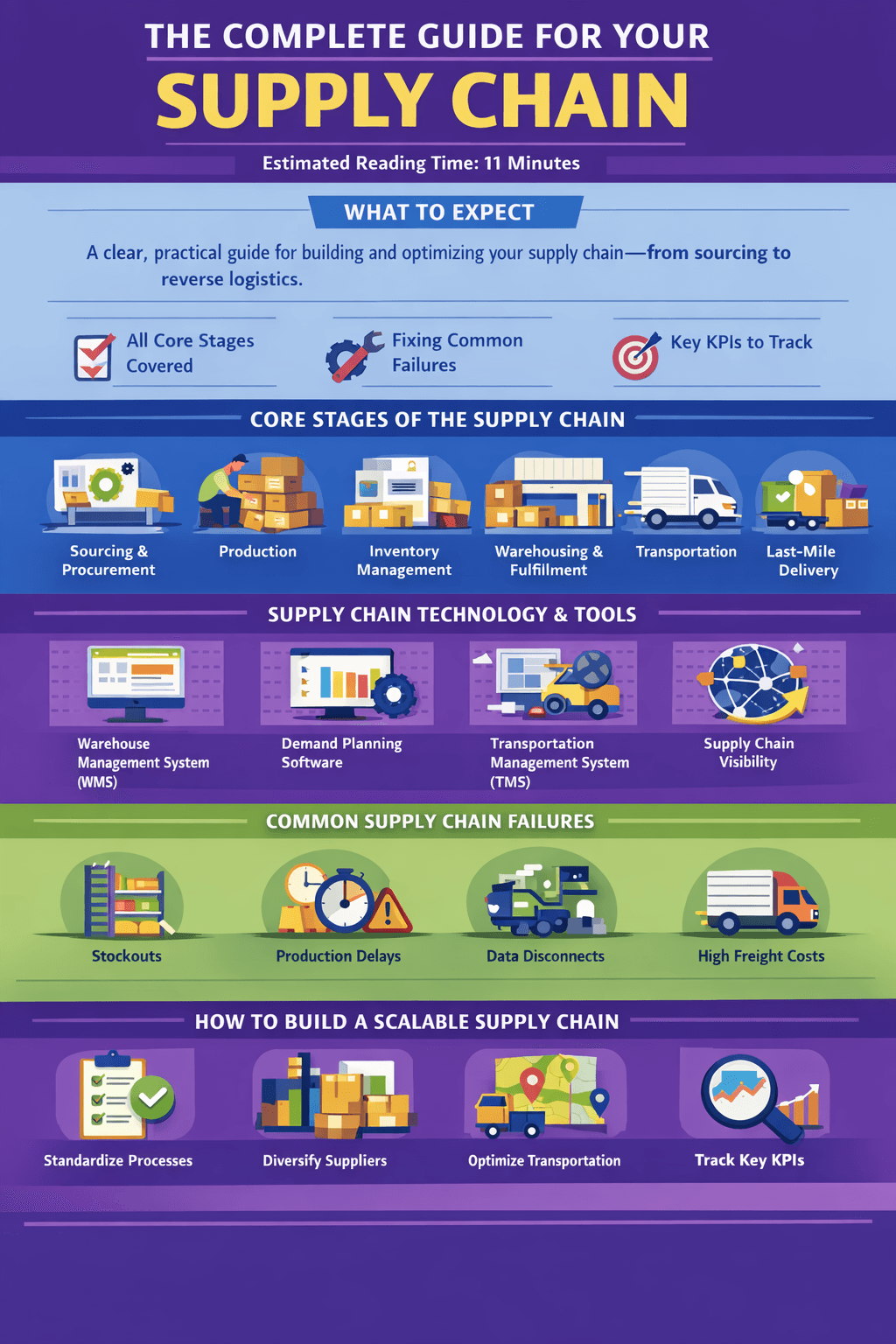
This guide is written for brand operators, logistics managers, and founders who manage physical goods and want a clear, no-fluff reference for building or improving a supply chain. It covers every major stage of the supply chain from procurement to reverse logistics, along with the technology stack that connects them, the most common failure points and how to fix them, the KPIs that actually matter, and a practical framework for scaling operations without losing control.
By the end, you will have a working mental model of how each stage affects the next, where to look when something breaks, and which decisions have the highest leverage at different stages of growth.
Table of Contents
What Supply Chain Management Actually Covers
The Core Stages of a Supply Chain
Sourcing and Procurement
Manufacturing and Production
Inventory Management
Warehousing and Fulfillment
Transportation and Carrier Management
Last Mile Delivery
Reverse Logistics
Supply Chain Technology and What to Prioritize
Common Supply Chain Failures and How to Fix Them
How to Build a Supply Chain That Scales
Supply Chain KPIs Worth Tracking
Building a Supply Chain That Works for Your Business
Every business that moves physical goods depends on a supply chain. Whether that chain spans three steps or thirty, the same principle applies: every weak link costs money, time, or customers. This guide covers the full scope of supply chain management, from foundational strategy to operational execution, so brands and logistics teams can identify where their chain is strong and where it needs work. The goal throughout is practical clarity, not theory for its own sake.
What Supply Chain Management Actually Covers
Supply chain management is the coordination of every activity involved in sourcing, producing, and delivering a product to an end customer. That definition sounds broad because it is. Supply chain management touches procurement, manufacturing, inventory planning, warehousing, transportation, and reverse logistics. Managing it well means those functions operate as a connected system rather than a series of handoffs between siloed departments.
A supply chain has two primary flows running in parallel: the physical flow of goods moving forward from supplier to customer, and the information flow that tells every participant in the chain what to produce, store, ship, and replenish. When both flows are synchronized, inventory lands in the right place at the right time. When they fall out of sync, the result is either stockouts that disappoint customers or excess inventory that ties up working capital.
Most supply chain problems are information problems first and physical problems second. A manufacturer that does not receive accurate demand signals builds the wrong quantity. A warehouse that does not receive advance shipping notices cannot schedule receiving efficiently. A carrier that does not receive accurate package data cannot route shipments optimally. Investing in the information layer of a supply chain often delivers faster returns than investing in physical infrastructure.
The Core Stages of a Supply Chain
Understanding the distinct stages of a supply chain makes it easier to diagnose problems, benchmark performance, and prioritize improvements. Each stage has its own metrics, failure modes, and optimization levers.
Sourcing and Procurement
Procurement is where the supply chain begins. This stage covers supplier selection, contract negotiation, purchase order management, and the quality standards that govern what acceptable goods look like when they arrive. Procurement decisions made here ripple through every downstream stage. A supplier with unreliable lead times creates inventory volatility. A supplier with quality control problems creates returns and rework costs that consume margin quietly over time.
Strong procurement practice includes dual sourcing for critical components, clear lead time agreements written into contracts, and regular supplier performance reviews that go beyond price to evaluate delivery reliability, defect rates, and responsiveness to exceptions. Brands that treat procurement as purely a cost-reduction function often discover downstream that the savings were borrowed from service quality.
Manufacturing and Production
For brands that own or contract manufacturing, production planning is the engine of the supply chain. Production schedules need to balance two opposing forces: the cost efficiency of long runs versus the flexibility of responding to demand changes. Batching too large builds inventory that may sit unsold. Batching too small increases changeover costs and reduces throughput.
Contract manufacturing introduces coordination complexity. When production happens outside the brand's direct control, quality audits, production visibility, and clear communication protocols become essential. Brands that lose visibility into contract production schedules often discover shipment delays only after they have already missed a restock window.
Inventory Management
Inventory is the buffer that absorbs variability across the supply chain, and managing it well is one of the highest-leverage supply chain disciplines. The core tension in inventory management is between carrying cost and stockout risk. Carrying too much inventory locks up cash and increases the risk of obsolescence, especially in product categories with short lifecycles or seasonal demand. Carrying too little inventory results in stockouts that disappoint customers and hand revenue to competitors.
Safety stock calculations should account for lead time variability, demand variability, and the service level the brand wants to maintain. A brand targeting a 98 percent in-stock rate needs more safety stock than one targeting 90 percent, and the math to determine how much more is not intuitive without modeling it explicitly.
SKU rationalization is another underused inventory lever. A catalog that has expanded organically over time often contains slow-moving SKUs that occupy warehouse space, complicate replenishment, and dilute the focus of the operation. Reviewing inventory turn by SKU annually and making deliberate decisions about discontinuation or consolidation frees up capital and operational capacity.
Warehousing and Fulfillment
The warehouse is where inventory strategy and order fulfillment intersect. Warehouse performance determines how quickly orders leave the building after they are placed and how accurately they are picked. Both speed and accuracy are directly controllable through process design, warehouse management system configuration, and labor training.
Slotting strategy, the deliberate placement of SKUs within the warehouse to minimize pick travel time, has an outsized impact on throughput. High-velocity SKUs placed near pack stations reduce picker walking distance on the orders that represent the largest share of volume. Seasonal or promotional SKUs can be repositioned in advance of demand spikes. Most warehouses that have not intentionally optimized their slotting are leaving meaningful throughput on the floor.
Cycle counting, the practice of counting a portion of inventory on a rolling basis rather than shutting down for a full physical count, keeps inventory records accurate without operational disruption. Accurate inventory records are the prerequisite for accurate order fulfillment. A warehouse that does not know where its inventory actually is cannot pick orders reliably.
Transportation and Carrier Management
Transportation is typically the largest variable cost in a supply chain, and the one with the most optimization surface area. Carrier selection, service level choices, packaging, and geographic distribution of inventory all affect what a brand pays to move goods and how fast customers receive them.
Rate shopping across carriers is standard practice in well-run fulfillment operations. The same package shipped to the same address can vary significantly in cost depending on which carrier, which service level, and which zone pricing applies. Automated rate shopping at the time of label generation ensures each shipment uses the most cost-effective option that still meets the delivery promise.
Mode optimization matters for inbound freight as well. Brands shipping domestically from suppliers have choices between parcel, LTL, and FTL depending on volume and timing. Moving from parcel to LTL at the right volume threshold, or consolidating inbound shipments to improve truckload utilization, often reduces freight cost meaningfully without changing lead times.
Last Mile Delivery
Last-mile delivery is the final and typically most expensive leg of the supply chain per unit of distance traveled. Delivering to individual residential addresses is inherently less efficient than delivering to commercial stops, and customer expectations around speed have increased steadily. Two-day delivery is now a baseline expectation in most product categories, and same-day or next-day delivery is increasingly competitive in urban markets.
Brands that want to compete on delivery speed without absorbing the full cost of expedited services have two primary levers: inventory positioning and carrier diversification. Positioning inventory closer to customer concentration through regional fulfillment centers reduces transit distance, which reduces both cost and delivery time using standard ground services. Adding regional carrier relationships alongside national carriers in markets where regionals offer better density often improves both service and cost simultaneously.
Reverse Logistics
Returns are a supply chain stage that many brands underinvest in operationally. The cost of reverse logistics extends beyond the carrier label. It includes receiving and grading returned merchandise, making disposition decisions, restocking sellable units, and processing refunds or exchanges on the customer-facing side. A returns process that is slow or manual ties up both capital and customer satisfaction.
Customer-facing returns experience has become a genuine competitive differentiator in e-commerce. Brands with friction-free returns portals, prepaid labels, and fast refund timelines retain customers at higher rates than those that make returns difficult. The operational investment in a smooth returns process typically pays back in lower customer acquisition cost and higher lifetime value.
Supply Chain Technology and What to Prioritize
Technology investments in the supply chain have compounded significantly in accessibility and capability. Tools that previously required enterprise-scale budgets are now available to mid-market and growing brands. The challenge is not finding technology. It is prioritizing which investments address the actual constraints in the current supply chain.
Warehouse Management Systems
A warehouse management system (WMS) is the operating system of a fulfillment operation. It directs receiving, putaway, picking, packing, and shipping through a combination of directed workflows and real-time inventory tracking. Brands operating without a WMS are managing warehouse activity through tribal knowledge, spreadsheets, or a basic inventory module that was not built for warehouse operations. The cost of that gap shows up in inventory inaccuracy, pick errors, and throughput limits.
WMS selection should be driven by the complexity of the warehouse operation, the number of sales channels, and the integration requirements with storefronts and carriers. A small operation with a single sales channel needs a different tool than one managing multi-channel order flow with custom kitting, lot tracking, and retail compliance requirements.
Demand Planning Software
Demand planning software uses historical sales data, seasonal patterns, and trend signals to generate replenishment recommendations at the SKU level. The alternative to demand planning software is spreadsheet-based forecasting, which becomes increasingly unreliable as catalog size, channel complexity, and lead time variability increase. Brands that consistently over-buy or under-buy across their catalog are usually operating without a credible demand signal.
Transportation Management Systems
A transportation management system (TMS) provides visibility and control over outbound shipment routing, carrier selection, and freight spend. At higher shipment volumes, a TMS enables rate shopping, carrier scorecarding, and exceptions management in a way that manual processes cannot replicate. For brands managing both parcel and freight, a TMS that handles both eliminates the need for separate systems and gives a complete view of transportation cost.
Supply Chain Visibility Platforms
End-to-end supply chain visibility means knowing where inventory is at every stage: in production, in transit inbound, in the warehouse, in transit outbound, and in the returns pipeline. For brands with complex supplier networks or long international lead times, visibility platforms that aggregate tracking data across carriers, freight forwarders, and warehouse systems reduce the risk of surprises and accelerate response when exceptions occur.
Common Supply Chain Failures and How to Fix Them
Most supply chain problems are not unique. They follow recognizable patterns, and each pattern has a set of known solutions.
The Bullwhip Effect occurs when small fluctuations in customer demand amplify into large swings in upstream production and procurement. A small demand increase at retail leads to a larger order from the distributor, which leads to an even larger production run at the manufacturer. The result is inventory piling up across the chain when demand normalizes. The fix is sharing point-of-sale data upstream so suppliers can see actual demand rather than responding to amplified order signals.
Supplier Concentration Risk is the exposure created when a single supplier accounts for a large share of a critical input. A quality problem, a capacity constraint, or a geopolitical disruption at one supplier can halt production across the brand's entire catalog. Dual sourcing for critical components, even at a slight cost premium, is standard risk management in mature supply chains.
Inventory Record Inaccuracy is endemic in warehouses that do not use barcode scanning for every transaction. When the system record diverges from physical reality, order accuracy suffers, and demand planning works from a corrupted baseline. The solution is a combination of scan-based transaction recording and a disciplined cycle count program that corrects discrepancies before they compound.
Poor Carrier Performance Visibility leaves brands unable to identify which carriers and service levels are failing on delivery promises until the customer complaints arrive. Building a carrier scorecard that tracks on-time performance, damage rates, and exception frequency by carrier and lane gives procurement the data to renegotiate contracts or redirect volume to better-performing options.
Disconnected Systems create the most pervasive supply chain inefficiencies. When the order management system, the WMS, and the carrier systems do not share data automatically, every handoff requires manual entry or file transfers. Manual entry introduces errors and delays at the exact points in the supply chain where speed and accuracy matter most. API integrations between systems eliminate manual handoffs and give every participant a real-time view of the same data.
How to Build a Supply Chain That Scales
A supply chain built for current volume often breaks under the demands of growth. The structural decisions that support a fast-scaling supply chain are different from those that optimize for today's operation.
Standardize processes before adding volume. A process that is barely working at low volume will fail visibly at high volume. The time to document, train, and systematize picking, packing, receiving, and returns workflows is before the peak season, not during it. Brands that invest in process standardization find that scaling adds volume without proportionally adding errors or costs.
Build carrier redundancy before you need it. Carrier capacity constraints during peak periods, service failures that strand shipments, or rate changes from a primary carrier can all disrupt the customer experience. Maintaining active relationships with multiple carriers, even if primary volume routes to one, ensures options are available when the primary option fails or becomes uncompetitive.
Position inventory for your actual customer geography. Most brands make inventory positioning decisions based on where their operations or headquarters are located rather than where their customers are. Analyzing order data by zip code and comparing it against the delivery speed and cost by fulfillment location is a supply chain optimization that many brands delay for years while paying for it in freight spend and transit time.
Choose logistics partners who share your growth trajectory. A 3PL partner, a freight broker, or a carrier account manager who has worked through scaling challenges with other brands brings operational knowledge that is difficult to acquire independently. The best logistics partnerships are built on shared data, transparent performance metrics, and a mutual interest in solving problems before they affect customers.
Supply Chain KPIs Worth Tracking
Measuring supply chain performance requires choosing the right metrics. The following KPIs cover the health of each major stage.
Order Fill Rate measures the percentage of orders shipped complete and on time without backorders or substitutions. This is the customer-facing output of inventory management and fulfillment execution. A fill rate below 95 percent typically signals inventory positioning or forecasting problems.
Inventory Turnover measures how many times the average inventory balance is sold and replaced within a period. Higher turnover indicates less capital locked in inventory relative to sales. Industry benchmarks vary by category, but a consistent downward trend in inventory turnover is a signal that demand planning or SKU rationalization needs attention.
Perfect Order Rate is the percentage of orders delivered complete, on time, undamaged, and with accurate documentation. It combines performance across fulfillment, carrier, and quality functions into a single metric. Perfect order rate is a demanding standard because it requires all components to succeed simultaneously, which is why it is useful as a composite health check on the supply chain overall.
Freight Cost as a Percentage of Revenue normalizes transportation spend against sales volume, making it comparable across periods of different scale. A rising freight cost percentage in the absence of changing service levels or carrier rates typically signals a carrier mix problem, a packaging optimization gap, or an inventory positioning opportunity.
Cash-to-Cash Cycle Time measures the number of days between paying suppliers for inventory and collecting cash from customers. Compressing the cash-to-cash cycle, by reducing days inventory outstanding, improving receivables collection, or extending supplier payment terms, directly improves working capital position and reduces the financing cost embedded in the supply chain.
Building a Supply Chain That Works for Your Business
A supply chain that runs well is a competitive advantage that does not show up on the product page but shows up in every customer's experience from order to delivery. Fast, reliable, cost-efficient fulfillment retains customers, supports growth, and generates the unit economics that allow brands to invest in the other parts of the business.
The supply chain decisions that matter most are not made once. They are reviewed regularly as volume, geography, product mix, and customer expectations evolve. The brands that treat supply chain management as a discipline rather than a back-office function tend to compound their operational advantages over time, while competitors are still reacting to the same problems year after year.
Start with an honest assessment of where the current chain loses time, accuracy, and money. Prioritize the one or two highest-impact fixes. Build those improvements into the process and measure the result. Then move to the next constraint. Supply chain optimization does not require a complete overhaul to deliver real results. It requires consistent, methodical attention to the stages that matter most for the business at hand.