
Blog
/
maximize-efficiency-with-our-3pl-logistics-services
Maximize Efficiency With Our 3PL Logistics Services
Jesse Stock
on
Maximize Efficiency With Our 3PL Logistics Services
Estimated Reading Time: 10 minutes · Published by: Shipping Bros 3PL, Springdale, AR · Last Updated: March 2026
What to Expect
This post is for brand operators and e-commerce businesses that are ready to stop leaving efficiency on the table in their fulfillment operation and want a clear picture of what maximizing that efficiency actually looks like through a 3PL logistics partner. It covers the specific functions, workflows, and technology that drive measurable gains in order accuracy, fulfillment speed, and cost per shipment, and what to expect when you outsource those functions to a provider who has already built the infrastructure to run them well. If you are actively comparing 3PL logistics services, trying to quantify what better fulfillment is worth to your business, or deciding whether now is the right time to make the move, this is the right place to start.
Table of Contents
What Maximizing Efficiency in 3PL Logistics Actually Looks Like
How 3PL Logistics Services Eliminate the Fulfillment Bottlenecks Costing You the Most
Warehouse Operations That Drive Speed and Accuracy at Volume
Carrier Strategy and How 3PL Logistics Reduces Your Cost Per Shipment
Inventory Management Efficiency That Prevents Stockouts and Excess Carrying Cost
Fulfillment Technology as the Engine of 3PL Logistics Efficiency
Value-Added 3PL Logistics Services That Extend Beyond Standard Fulfillment
How to Measure Whether Your Current 3PL Logistics Setup Is Maximizing Efficiency
How Shipping Bros 3PL Maximizes Fulfillment Efficiency From Springdale, AR
Efficiency in fulfillment is not an abstract goal. It is the difference between a cost per order that improves as your business scales and one that compounds against you. It is the difference between a two-day delivery promise you can make with confidence and a three-to-five day window that costs you the sale before the customer finishes reading the checkout page. It is the difference between an operation you can hand off and one that requires constant attention to keep from falling behind.
3PL logistics services exist to give growing brands access to the operational infrastructure, carrier relationships, and fulfillment technology that maximize efficiency from day one, without the capital investment and timeline required to build those capabilities independently. The brands that use them well ship faster, spend less per order, and scale without rebuilding their logistics operation at every stage of growth.
What Maximizing Efficiency in 3PL Logistics Actually Looks Like
Maximizing efficiency in a 3PL logistics operation means every step in the fulfillment cycle is designed to move inventory toward the customer as quickly and accurately as possible, with the minimum amount of labor, error, and cost attached to each transaction. That standard applies across inbound receiving, inventory management, order picking and packing, carrier selection, and returns processing.
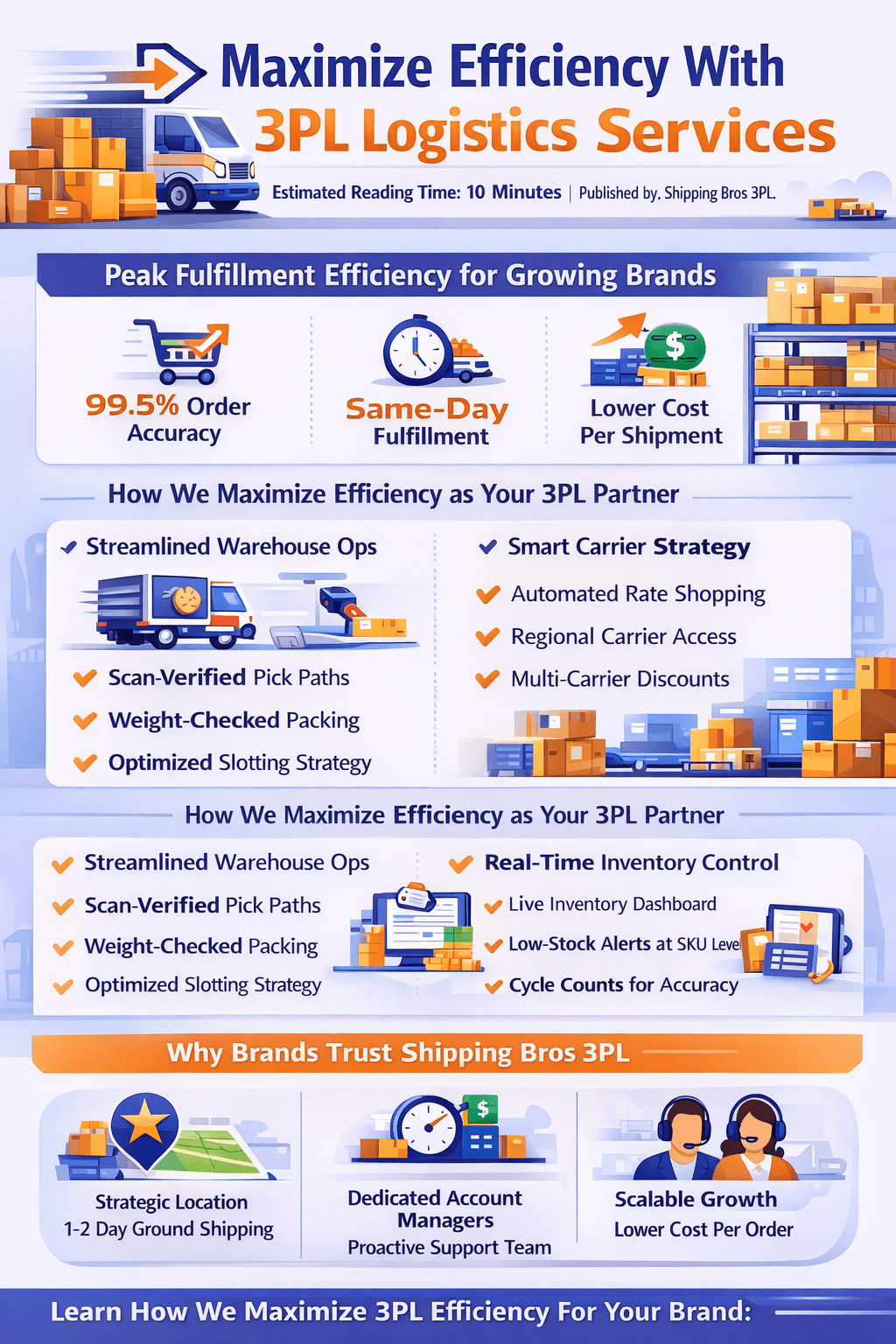
In practice, a maximally efficient 3PL logistics operation receives inbound inventory same day and makes it available for order picking within hours. Orders flow from connected storefronts into the warehouse management system automatically and generate pick lists without manual input. Pickers follow directed routes that minimize travel distance per order. Every pick is scan-confirmed against the open order. Every packed carton is weight-verified before a label is generated. Outbound shipments are rate-shopped across carriers in real time and leave the building the same day they were ordered, assuming they arrive before the daily cut-off.
The cumulative result of each of these efficiency gains is an operation that processes more orders per labor hour, makes fewer errors per thousand orders, spends less per shipment, and delivers on the brand's customer promise more consistently than an unoptimized self-fulfillment operation can match. For brands evaluating 3PL logistics services, this standard is the benchmark to hold every prospective provider against.
How 3PL Logistics Services Eliminate the Fulfillment Bottlenecks Costing You the Most
Fulfillment bottlenecks do not always announce themselves clearly. They accumulate gradually as volume grows, and by the time they are visible in customer complaints or margin erosion, they have usually been costing the business for longer than anyone recognized. Understanding where the most expensive bottlenecks form, and how 3PL logistics services eliminate them, is the starting point for a real efficiency conversation.
Slow inbound receiving is one of the most common and most costly bottlenecks in self-managed fulfillment. When inventory arrives and sits in a receiving queue for two or three days before it is scanned into the system and available for orders, brands carry more safety stock than their actual demand requires just to cover the receiving lag. That excess inventory ties up working capital and occupies warehouse space. A 3PL fulfillment center with a dedicated receiving team, advance shipping notice requirements, and a same-day receiving standard eliminates this bottleneck at the root.
Manual order processing creates a lag between order placement and pick list generation that costs same-day fulfillment on a percentage of daily order volume. Orders that have to be manually downloaded, formatted, and imported into the warehouse system before picking can begin will miss the daily ship cut-off on busy afternoons. Direct API integrations between storefronts and the warehouse management system close this gap completely, making every order actionable within minutes of placement regardless of the time of day.
Unoptimized pick paths waste labor minutes on every single order. A picker who covers 30 percent more floor distance per order than an optimized route requires is effectively completing 30 percent fewer orders per shift. Warehouse management systems that direct picks along shortest-path routes, and fulfillment center layouts that slot high-velocity SKUs near pack stations, reduce pick time per order measurably and increase daily throughput without adding headcount.
Single-carrier dependency leaves brands vulnerable to rate increases, volume constraints during peak periods, and service failures that strand shipments without an alternative. 3PL logistics services that rate-shop across multiple carriers on every outbound shipment eliminate single-carrier dependency and consistently select the fastest, most cost-effective option for each specific destination and package profile.
Warehouse Operations That Drive Speed and Accuracy at Volume
The warehouse floor is where 3PL logistics efficiency is won or lost on a transaction-by-transaction basis. Technology and process design determine how fast orders move through the pick-pack-ship cycle and how accurately they are assembled before they leave the building.
Directed picking, managed through the warehouse management system, routes each pick to the correct bin location along an optimized path and confirms the pick through barcode scan before allowing the workflow to advance. This removes the two most common sources of pick error: wrong location and wrong item. In high-volume fulfillment operations, scan-directed picking consistently produces order accuracy rates at 99.5 percent or above. Operations running without scan direction rely on visual identification and memory, both of which degrade under volume pressure and time constraints.
Batch picking and wave management allow multiple orders to be picked simultaneously when they share items or zone locations, dramatically increasing picker productivity on high-velocity SKUs. The warehouse management system groups orders into optimized batches based on item overlap, fulfillment deadline, and carrier cut-off, which reduces the total number of pick walks required to clear a given volume of orders.
Pack station weight verification adds a second accuracy gate after picking. A packed carton is weighed and compared against the expected weight for the order. If the carton is too light, a unit is missing. If it is too heavy, something was added that should not have been. Either condition flags the order for review before the label is printed. This dual-gate accuracy model, scan at pick and weigh at pack, is what drives sustained accuracy performance in 3PL logistics operations that handle serious volume.
Fulfillment center slotting strategy determines how inventory is physically organized within the warehouse. High-velocity SKUs slotted near pack stations reduce the average pick distance on the orders that represent the largest share of daily volume. Seasonal and promotional SKUs repositioned in advance of demand spikes reduce the disruption that high-velocity windows create in an otherwise steady-state layout. A 3PL logistics provider that actively manages slotting as demand patterns change is capturing efficiency gains that a static warehouse layout leaves unrealized.
Carrier Strategy and How 3PL Logistics Reduces Your Cost Per Shipment
Carrier cost is typically the largest variable in the cost per order equation for an e-commerce business, and it is also the variable with the most optimization potential when managed through a capable 3PL logistics partner.
The rate leverage a 3PL provider brings to carrier negotiations is the most direct cost reduction mechanism. A 3PL logistics operation shipping hundreds of thousands of packages per month across its full client base negotiates carrier rates that reflect that aggregate volume. The individual brand shipping a fraction of that total has proportionally less negotiating leverage and pays proportionally more per shipment for equivalent service. Accessing carrier rates through a 3PL fulfillment partner typically reduces outbound shipping cost on every shipment, which compounds into significant total freight savings at scale.
Automated carrier rate shopping evaluates every eligible carrier and service level for each individual shipment at the time of label generation. The evaluation criteria reflect the brand's delivery promise, matching the least expensive qualifying service to the destination, weight, and dimensions of each specific package. This logic runs on every order without manual review, which means the savings apply across the entire daily shipment volume, not just the orders where someone takes the time to compare rates manually.
Regional carrier access is an efficiency lever that many brands have not fully exploited. In high-density shipping corridors, regional carriers offer faster transit and lower rates than national carriers routing packages through multiple hubs. A 3PL logistics provider with established regional carrier relationships and those connections integrated into the rate shopping workflow delivers better outcomes in those corridors than a brand whose carrier strategy is limited to the three major nationals.
Geographic positioning of the fulfillment center relative to customer concentration affects every shipment's zone rating and therefore its cost. Shorter average zone distance means lower average cost per shipment across the entire order volume. For brands whose customers concentrate in the south-central United States, fulfilling from Springdale, AR keeps average zone distance short and average cost per shipment low on a substantial share of total outbound volume.
Inventory Management Efficiency That Prevents Stockouts and Excess Carrying Cost
Inventory management efficiency is the discipline that keeps the right amount of the right product available at the right time without tying up unnecessary capital in slow-moving stock or running short on fast-moving items. In a 3PL logistics context, this discipline operates through the warehouse management system, the client dashboard, and the shared data connection between the fulfillment operation and the brand's purchasing team.
Real-time inventory visibility is the foundation. When a brand's purchasing team can see on-hand quantities, reserved quantities against open orders, and inbound replenishment quantities in a single live view, they have the information to make accurate reorder decisions. Without that visibility, purchasing decisions rely on reports that are hours or days old, which is often enough lag to miss a reorder window on a fast-moving SKU.
SKU-level low-stock alerts configured in the 3PL's warehouse management system notify purchasing teams when on-hand inventory falls below a defined threshold. Setting those thresholds correctly requires factoring in supplier lead time and demand rate so the alert fires with enough advance notice to reorder before the stockout, not at the moment the last unit ships. A 3PL logistics partner who helps clients configure these thresholds based on their actual SKU velocity and supplier lead time data is providing a service that directly reduces the revenue cost of stockouts.
Cycle counting discipline, the practice of continuously counting a portion of inventory on a rolling schedule rather than running a single annual physical count, keeps inventory record accuracy above the threshold where it can be trusted for demand planning and available-to-promise commitments. 3PL fulfillment operations that run structured cycle count programs through their warehouse management system maintain inventory accuracy consistently above 99 percent, which is the standard that reliable order fulfillment and accurate demand planning both require.
Fulfillment Technology as the Engine of 3PL Logistics Efficiency
Technology is not a feature of a modern 3PL logistics operation. It is the operational layer that determines whether the physical work of fulfillment is fast, accurate, and scalable, or slow, error-prone, and labor-intensive. The difference between a 3PL provider running on current fulfillment technology and one running on legacy systems or manual processes shows up in every performance metric a brand cares about.
The warehouse management system is the core. A properly configured WMS directs every fulfillment workflow, enforces accuracy controls through scan verification, tracks inventory location in real time, manages carrier integrations, and provides the data layer that client reporting and performance management run on. Evaluating the WMS a 3PL provider uses, and understanding how it is configured for the specific workflows relevant to a brand's order profile, is the most important technology evaluation in the 3PL selection process.
Storefront integrations that connect directly via API to Shopify, WooCommerce, Amazon, Walmart, and other platforms eliminate the manual processing lag that batch-import workflows create. Orders are actionable in the warehouse within minutes of placement. Inventory levels sync back to the storefront in real time. Tracking information flows back automatically and triggers branded shipping confirmation emails to the customer without any manual step on the brand's side or the 3PL's.
Client-facing dashboards that provide real-time visibility into inventory, order status, outbound shipments, and returns give brand operators the operational data they need to manage their business rather than waiting for weekly or daily reports that are already out of date by the time they arrive. A 3PL logistics partner whose technology investment includes a live client dashboard is operating at a transparency standard that reflects confidence in the quality of their own operation.
Value-Added 3PL Logistics Services That Extend Beyond Standard Fulfillment
Standard pick-and-pack fulfillment covers the baseline of what a 3PL logistics provider delivers. Capable providers extend their service offering into value-added functions that allow brands to consolidate more of their supply chain operations within a single fulfillment partner rather than managing separate vendors for adjacent services.
Kitting and assembly services allow brands to offer bundled products, subscription boxes, gift sets, and promotional configurations without pre-assembling them before sending inventory to the fulfillment center. The 3PL builds each kit configuration on demand based on order specifications, which eliminates the need to carry pre-built kit inventory for every possible combination and reduces the waste associated with kits that need to be broken down when configurations change.
Custom packaging and branded unboxing services execute the physical brand experience at the point of delivery. Branded boxes, tissue paper, ribbon, inserts, and handwritten note options are managed within the fulfillment center and applied consistently across every applicable order. For premium brands where the unboxing moment is part of the product experience, this capability within the 3PL logistics operation is a direct extension of the brand promise.
Retail compliance services prepare inventory to the routing guide and labeling standards that big-box retail partners require for vendor compliance. Non-compliance chargebacks from retail partners are a fast-growing cost for brands entering wholesale and retail distribution channels. A 3PL logistics provider with retail compliance capability manages EDI connections, carton labeling, pallet configuration, and routing requirements to keep chargebacks at zero.
How to Measure Whether Your Current 3PL Logistics Setup Is Maximizing Efficiency
The most reliable way to evaluate whether a current 3PL logistics arrangement is actually maximizing efficiency is to measure the operation against the specific KPIs that reflect performance at each stage of the fulfillment cycle.
Order accuracy rate should be at or above 99.5 percent. A rate below this threshold means the fulfillment operation is generating a measurable volume of wrong-item and wrong-quantity shipments, each of which costs a reshipment, a return label, and a customer service interaction that the business is funding.
Fulfillment cycle time, measured from order placement to label generation, should be under two hours for orders placed before the daily cut-off. Cycle times that consistently stretch to four or six hours indicate a process bottleneck in order flow, pick management, or pack station throughput that is costing same-day fulfillment on a share of daily volume.
Inbound receiving speed should be same-day or next-business-day from truck arrival to system availability. Multi-day receiving queues are forcing excess safety stock that ties up working capital unnecessarily.
Freight cost as a percentage of revenue should be trending flat or down as order volume grows. A freight cost percentage that rises with volume is a signal that carrier rate access is not scaling with the business, which is precisely what 3PL logistics carrier leverage is designed to prevent.
Inventory record accuracy should be at or above 99 percent. Record accuracy below this level means demand planning, available-to-promise commitments, and reorder decisions are all being made on data that does not reflect physical reality.
How Shipping Bros 3PL Maximizes Fulfillment Efficiency From Springdale, AR
Shipping Bros 3PL is an asset-based 3PL logistics provider in Springdale, AR built around the operational standards that maximizing fulfillment efficiency requires. Inbound inventory is received and available for order picking same day in most cases. Orders from Shopify, WooCommerce, Amazon, and Walmart flow into the warehouse management system automatically through direct API integrations the moment they are placed. Pick lists are generated immediately and directed to warehouse staff along optimized paths. Every pick is scan-verified against the open order before it leaves the bin. Every packed carton is weight-checked before a label is printed.
Outbound fulfillment is rate-shopped in real time across UPS, FedEx, USPS, and regional carriers on every shipment. Tracking pushes back to the storefront automatically. Clients have live visibility into inventory levels, open orders, and outbound shipments through a real-time dashboard. Low-stock alerts fire at the SKU level with thresholds configured for each product's lead time and demand rate. Returns are received, graded, and restocked fast so inventory accuracy holds and refunds process without delay.
Springdale, AR puts a one to two day ground transit radius around Dallas, Kansas City, Memphis, St. Louis, Oklahoma City, Nashville, Tulsa, and Little Rock. Brands fulfilling from coastal warehouses and paying expedited rates to hit two-day delivery windows for south-central customers find that Springdale ground service matches that delivery promise at a fraction of the cost. The freight savings typically land in the 15 to 30 percent range on affected shipments, with no reduction in delivery speed from the customer's perspective.
Every client works with a dedicated account team based in Springdale with direct knowledge of the catalog, the fulfillment configuration, and the service level requirements. When an exception needs a fast decision, the answer comes from someone who knows the account, not a general support queue.
If you are ready to stop measuring the gap between your current fulfillment performance and what a maximally efficient 3PL logistics operation delivers, bring your order volume, your current fulfillment costs, and your storefront setup. We will show you exactly what maximizing efficiency through Shipping Bros looks like for your business.